Research Introduction
My research focuses on machine learning and data mining, spanning a wide spectrum of models and algorithms. Among these, I place particular emphasis on graph-based techniques.
A graph (also referred to as a network) provides a powerful way to represent complex systems as a set of entities and their interactions. Each node represents an entity such as a person, organization, city, or device, while each edge represents a relationship between them, such as communication, collaboration, trade, or proximity. This flexible representation allows complex systems, including social communities, transportation networks, the web, and biological pathways, to be modeled and analyzed within a unified framework. By studying these graph data, we can uncover patterns that shed light on diverse social and industrial phenomena and develop data-driven solutions to real-world problems.
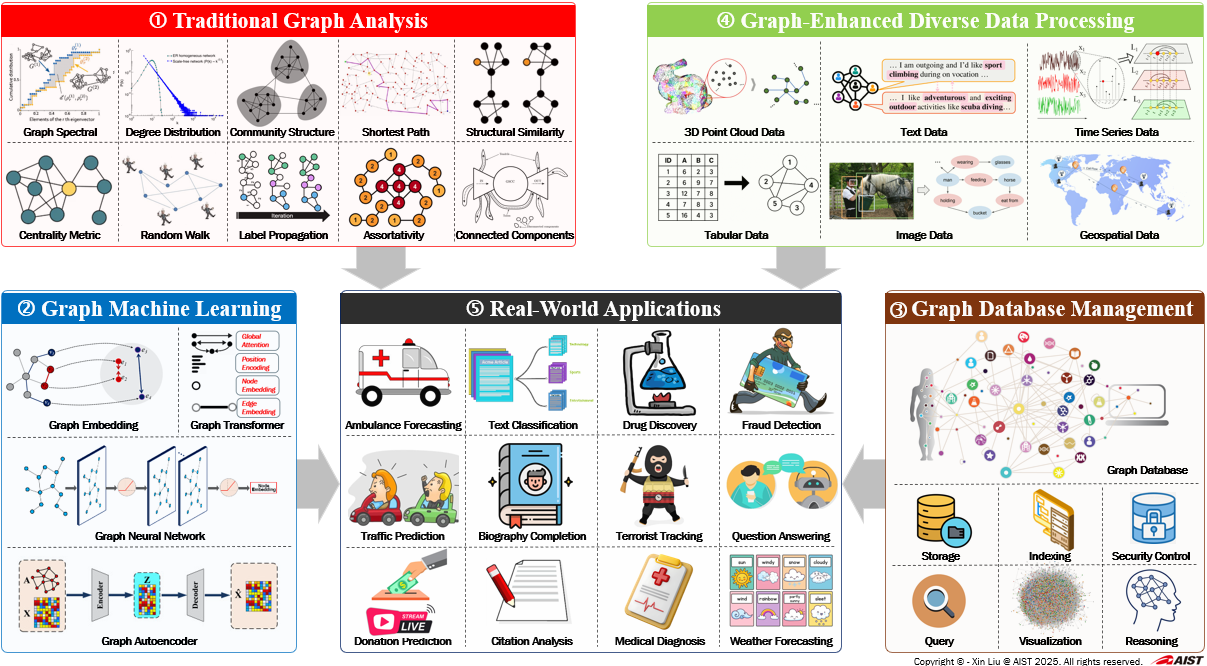
As illustrated in Figure 1, my research evolves across five interconnected directions, forming a coherent framework that integrates theory, algorithms, systems, and applications:
① Traditional Graph Analysis
This direction systematically analyzes the structural properties of graphs using fundamental techniques from classical graph theory and statistical physics. These include degree distributions, degree correlations, centrality measures, spectral analysis, random network models, shortest paths, reachability analysis, random walks, network partitioning, and synchronization phenomena on networks.
② Graph Machine Learning
This research applies machine learning and deep learning techniques to perform representation learning, prediction, and inference on graph data. Our work focuses on four key challenges: (a) Improving predictive accuracy; (b) Developing learning techniques for new graph analysis tasks such as node ranking and community detection; (c) Creating models to various graph types, such as bipartite graphs, dynamic graphs, and heterogeneous graphs; (d) Establishing robust learning models for imperfect graphs to enhance practical utility.
③ Graph Database System and Large-Scale Graph Processing
This direction explores efficient technologies for the storage, indexing, approximate search, access control, and visualization of large-scale graphs. Through distributed and parallel learning frameworks, it ensures computational scalability for graphs with hundreds of millions of nodes and edges.
④ Graph-Enhanced Techniques for Diverse Data Processing
This research extends graph processing methodologies to a variety of data modalities, including 3D point clouds, text, time series, images, geospatial data, and tabular data. It proposes advanced analytical models for cross-modal and multimodal integration.
⑤ Real-World Applications
This direction applies developed theories, models, and algorithms to real-world datasets, addressing practical challenges across diverse domains. Representative applications include donation prediction in YouTube Live, completion of missing biographies in Wikipedia, diagnosis of brain disorders, demand forecasting for emergency medical services, product recommendation, citation recommendation, trend prediction in social media, antibiotic selection support, and inference of disease-subtype-specific gene networks.