
| Particlate Black Carbon and Sulfate in the MBL
Measured in the Series in the Series of Research Cruises and on a Sub-tropical Island (Chichi-jima Island) over the North Pacific Naoki KANEYASU |
|
1.Background of this study
The North Pacific region, which is located downwind of the Asian Continent, is anticipated to suffer from increasing effects of air pollutants such as sulfur dioxide, sulfate aerosol, and black carbon aerosol as a consequence of rapid increase in coal consumption and the industrialization of China. However, there has been very little observational data reported in this area. This may be a result of the geographical configuration of the islands in the mid-Pacific, because most of which are located south of 25 oN latitude, which is in the trade (easterly) wind regime. In the vast region of the North Pacific Ocean between Midway Island (28 oN) and Shemya Island (52 oN, in the Aleutian chain), which is in the westerlies regime, there have been practically no measurements for long-range transport of pollutants form Asia. We therefore conducted a series of shipboard measurements over the mid-Pacific Ocean. In addition, we have recently started long-term measurements of aerosol components and related optical parameters at Chichi-jima Island, Japan |
|
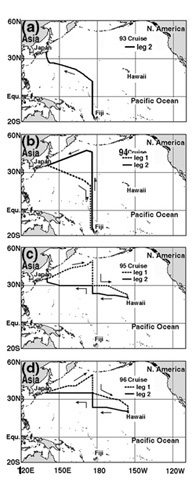
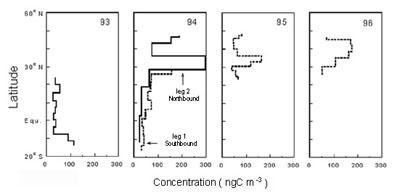
2.High concentration of black carbon measured in the middle of North Pacific Ocean Aerosol sampling was conducted aboard the R/V Hakurei-maru (Fig.1) in the mid-Pacific and en route to Japan (Fig.2) during four successive years (1993-1996). In the tropical-subtropical trade winds zone, continuous low concentrations of black carbon(> 40 ngC m-3) were measured. In contrast, extraordinary high concentrations of black carbon (> 150 ngC m-3) were measured in the 27o-38oN latitude zone (Fig.3). |
|
|
|
| Fig.1 The location of aerosol sampling inlet at the bow of R/V Hakurei-maru | |
|
Fig.3 Latitudinal variations of black carbon concentration (Dp <2 μm) measured in the research cruises of 1993 summer,1984 spring,1995 summer, and 1996 summer. |
Fig.2 Cruise tracks in the 1993-1996 shipboard measurements
|
|
3.Mass size distribution components in the
middle of high concentration zone.
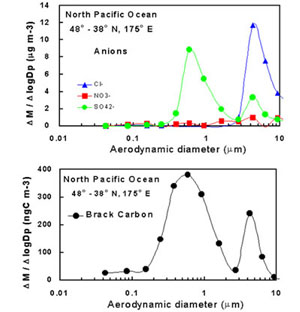
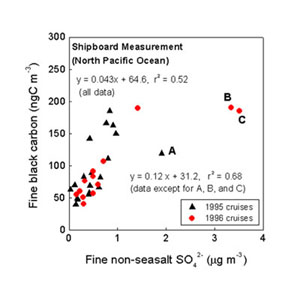
In this mid-latitude high concentration zone (38o - 48oN section in the 1996 cruise), mass size distributions of aerosols components collected by a cascade impactor exhibit remarkable characteristics (Fig.4).The peak in the black carbon resides in considerably large sizes(0.5 - 0.7 μm) compared to those normally found in freshly emitted diesel particles (~0.1 μm in mass size distribution). In addition, the peaks in the black carbon and sulfate in the sub-micron size range overlap each other. The concentrations of black carbon and non-seasalt SO42-in fine aerosols (Dp < 2 μm) show a good correlation (Fig.5). |
|
 |
 |
|
Fig.4 Mass size distribution of aerosol components
measured the middle of high concentration zone in 1996 cruise |
Fig.5 Comparison of the concentrations of black carbon and non-seasalt SO42- in fine aerosols
(Dp < 2 μm) measured in 1996 research cruise |
|
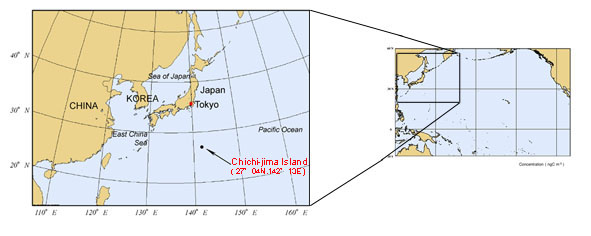
4.Long-term measurement of aerosol components at Chichi-jima Island,Japan To characterize the polluted airmass observed in these cruises,we established a monitoring site on a mountain (290m msl) in Chichi-jima Island, Japan (27o04' N, 142o13' E, Fig.6) .The Island is located on the transitional latitude between trade wind zone and westerly wind zone. Thus, this site is advantageous in monitoring both clean marine air (in trade wind) and continentally influenced air (westerly wind). |
||
 |
|
Fig.6 Map showing the location of Chichi-jima Island ( 1000 km south of the mainland Japan,and about 1800 km east of the Asian continent ) |

|
|
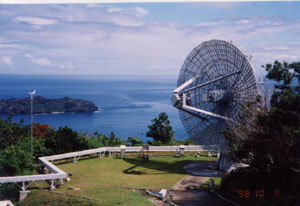 |
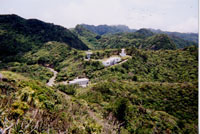
| Fig.7 Pictures around the sampling site (290 m msl.) | ||
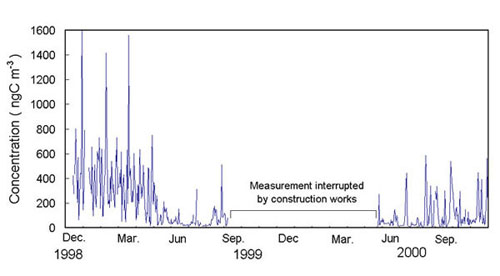
| From the continuous monitoring of absorption coefficient by an Aethalometer ( adopted specific absorption coefficient = 9.8 m2 g-1), a clear seasonal variation of black carbon concentration in MBL has been observed (Fig.8). The concentration of black carbon was high (> 300 ngC m-3) from December through early May when the continentally influenced air mass covered the area. During the rest of the months when the air blowing from the North Pacific Anticyclone dominated the area it was consistently low (< 40 ngC m-3). The values of high and low concentrations are in consistent with those in the mid-latitude westerly wind zone and in the trade wind zone, respectively, over the mid-Pacific Ocean. | ||
 |
||
|
Fig.8 Daily averaged black carbon concentration measured by an Aethalometer
( adopted specific absorption coefficient = 9.8m2g-1 ) |
 |
 |
|
|
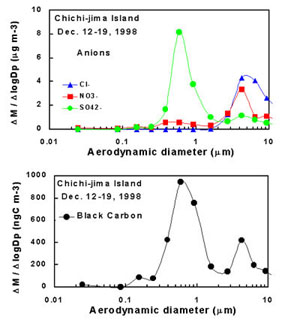
Fig.9 Same as Fig.4 but for the aerosols measured at Chichi-jima Island in winter |
Fig.10 Same as Fig.5 but for the aerosols measured at Chichi-jima Island |
|
| The mass size distributions of aerosol components at Chichi-jima in winter exhibit similar characteristics with those measured in the mid-latitude high concentration zone in the 1996 cruise (Fig.9). The concentrations of black carbon and non-seasalt SO42-in fine aerosol ( Dp < 2 μm )also have good correlation (Fig.10 ),although the ratio of black carbon is higher than that in the mid-Pacific. | ||
 |
||
| Fig.11 Aerosol optical depth at 500 nm wavelength measured at Chichi-jima Island | ||
|
5.Summary
Continentally influenced aerosols measured in winter at Chichi-jima Island have almost identical characteristics with that observed over the mid-Pacific (1750E) in the westerly wind zone. Thus,the chemical microphysical, and optical characteristics of aerosols measured at Chichi-jima site can be one of the representative data in modeling the long-range transported aerosols over the North Pacific region. However, seasonal variation of aerosol optical depth show slightly different pattern from that of aerosol components in the MBL, i.e., spring increases in the optical depth presumably due to soil-dust ( Fig.11 ). Thus, further studies are needed on the vertical distribution of aerosol. |
| HomepageTop |